
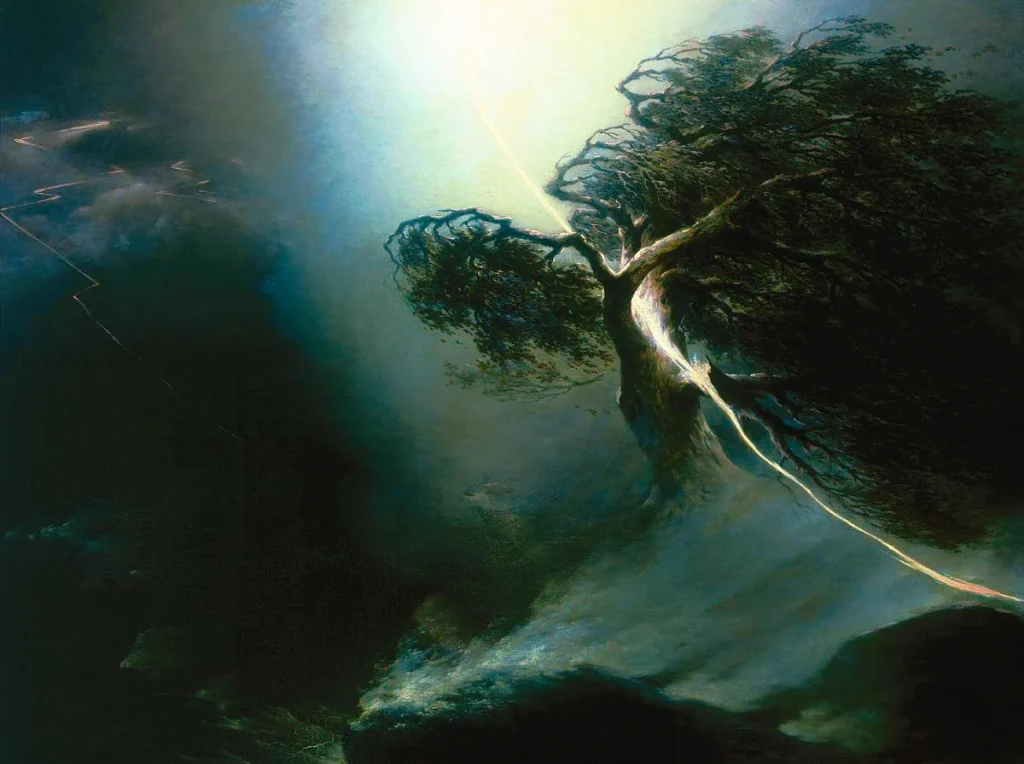
Perun is the Slavic god of thunder and lightning, the thunderer who strikes from on high at whatever threatens the order of the world. Of all the Slavic gods, he is the one we know most about: Byzantine writers and the Old Russian chronicles mention him, and his name lives on in language, in the names of hills and in folk custom, here in Croatia too.
Much of what is written about Perun today, though, is not recorded in any old source. It is later reconstruction. In this article we keep the two apart: what is attested, what is a reasonable guess, and what is a romantic story. For us this is more than interesting history. Our watches carry his name.
Who was Perun?
Perun is the god of thunder, lightning and the sky in the pre-Christian religion of the Slavs. In the Old Russian sources he is the god by whom treaties were sworn, and his idol stood first in the sanctuary at Kyiv. His weapon is lightning, imagined as an axe, a hammer or a stone arrow; his tree is the oak; his place is high up, on a hilltop or in the crown of a tree. The best-known story about him, his battle with his adversary Veles, is a modern scholarly reconstruction, as we explain below.
What does the name Perun mean?
The name goes back to Proto-Slavic Perunъ, from the verb perti, “to strike”, with a suffix for the one who does the action. Perun is, quite literally, “the striker”. The same word also meant thunder itself: the Polish for a thunderbolt is still piorun. In Croatian his name survives in perunika, the iris.
What the oldest sources say about Perun
The first account of the Slavs’ religion comes from a Byzantine writer of the 6th century. The Slavs, he says, believe in one god, the maker of the lightning, who is lord of all. He never names him, but he very likely means Perun.
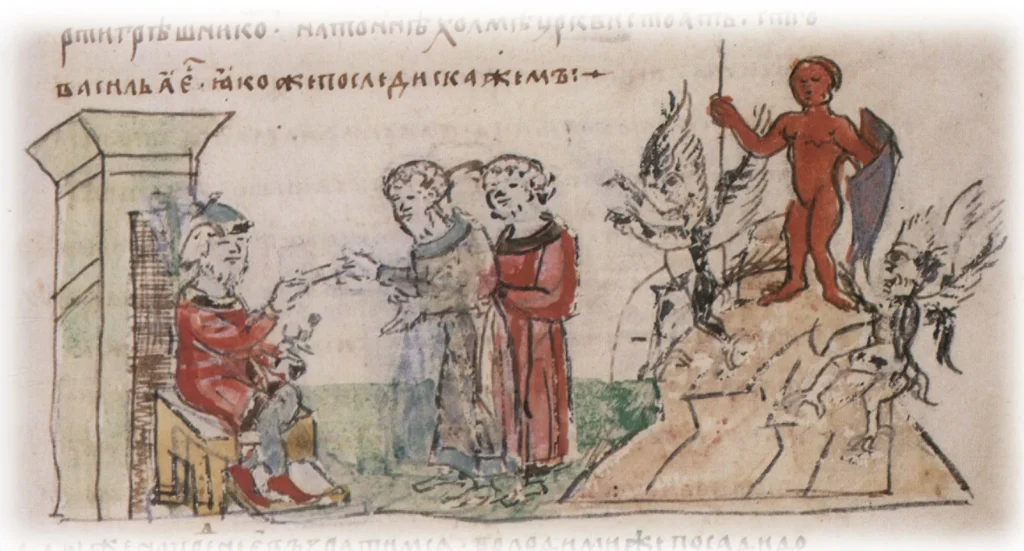
The name Perun itself first turns up in an old chronicle of Kyiv. Princes and their warriors swear by Perun when they make peace, and Prince Vladimir sets up his wooden idol on a hill above Kyiv, with a head of silver and a mustache of gold. A few years later Vladimir became a Christian and had the same idol dragged down the hill and thrown into the Dnieper.
Perun and Veles: the myth of the divine battle
You will often read a story like this. Perun sits at the top of the world tree, while down among the roots lurks his adversary Veles, the serpent-like lord of the underworld and of cattle. Veles steals Perun’s cattle, his wife or the waters; Perun hunts him down and hurls lightning at him; Veles hides in trees, rocks and animals; and when the thunderer finally strikes him, rain pours from the sky.
You will not find that story written down from beginning to end. A thunderer chasing a serpent or the devil turns up in folk tales, songs and customs all over the Slavic world, and scholars pieced the whole myth together from those fragments. The honest way to put it is that this is a probable picture, not a recorded story. We have written more about Perun’s adversary in In the Shadows of Myth: The Story of Veles.
Perun’s symbols
Ask what Perun’s symbol is and the answer depends on how strictly you read the sources. Here is what lies behind the ones you will see most often.
The oak
The oak is a tree lightning often strikes, and across the Indo-European world it has long been sacred to thunder gods, from Greek Zeus to Baltic Perkūnas. In the reconstructed Slavic myth, Perun sits at the top of an oak that stands for the world tree. Byzantine sources confirm that the Slavs revered great trees and made offerings to them, but they do not connect them with Perun by name.
The axe and stone arrows
Perun’s weapon is lightning, and in folk belief it takes a solid shape: a stone, a hammer or an axe. Across the Slavic and Baltic world, people who dug up prehistoric stone axes took them for thunderbolts fallen from the sky and kept them as protection against lightning.
The eagle
In Katičić’s reconstruction, Perun sits at the top of the tree in the form of an eagle or a falcon, while Veles waits below as a serpent. The eagle is Perun’s bird in the reconstructed myth, then, rather than in any medieval record.
The thunder mark
For centuries, people carved a six-spoked wheel or six-petal flower in a circle into beams, gables and distaffs. In Russian and Belarusian villages, ethnographers recorded that it was carved to protect the house from thunder, and in places people called it outright a thunder sign. That much is solid. That it is Perun’s sign specifically is a 20th-century scholarly reading, and the same motif turns up all over Europe, from the Alps to Scandinavia, where it is linked with the sun or with saints. In Croatia today it is usually called gromoviti znak, the thunder mark, or Perun’s mark.
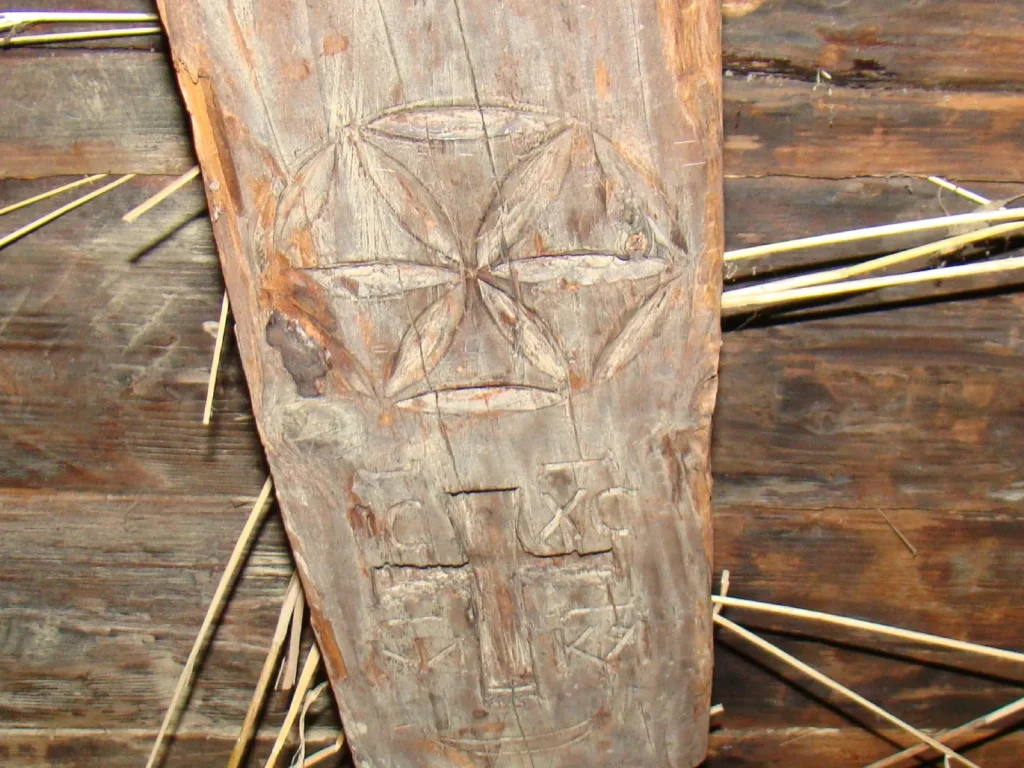
On this beam from 1681, the mark sits directly above the cross. The old and the new protectors of the house lived side by side for centuries.
The iris
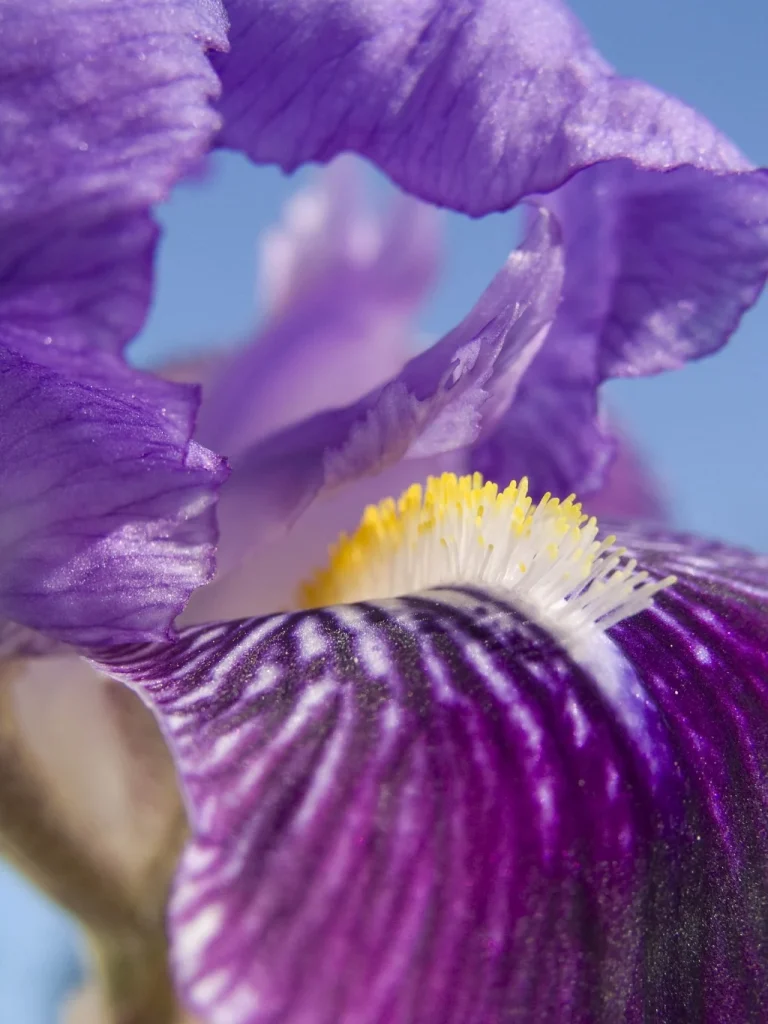
The iris, perunika in Croatian, carries Perun’s name. Legend has it that it springs up wherever lightning has struck, and around Dubrovnik people once carried a blessed iris home to keep the house safe from thunder. Today the Croatian iris is seen as Croatia’s national flower.
St Elijah the Thunderer
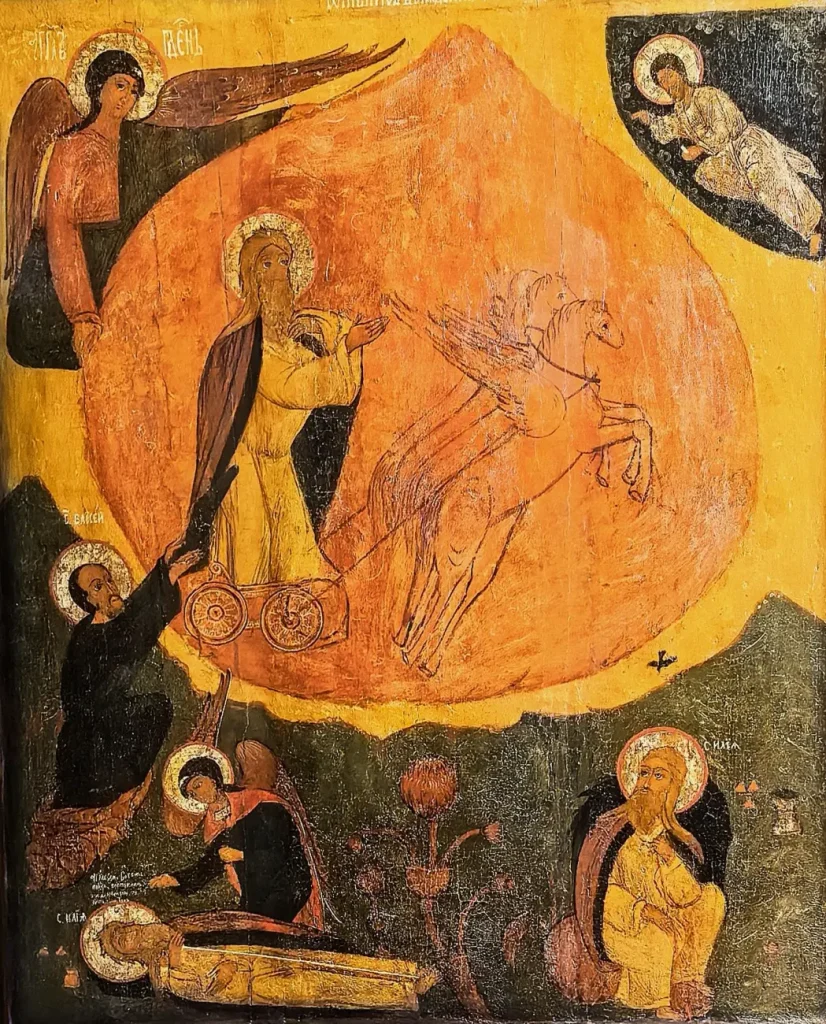
When the Slavs became Christian, the thunder did not go without a master. In folk belief, Perun’s role passed to the prophet Elijah, whom the Bible describes rising to heaven in a chariot of fire, and he is still called Elijah the Thunderer. His feast falls on 20 July, in the middle of the summer storm season.
Curiously, the two already meet in the oldest chronicle: while the pagans swear by Perun, the Christians take their oath in the church of St Elijah.
Perun in Croatia
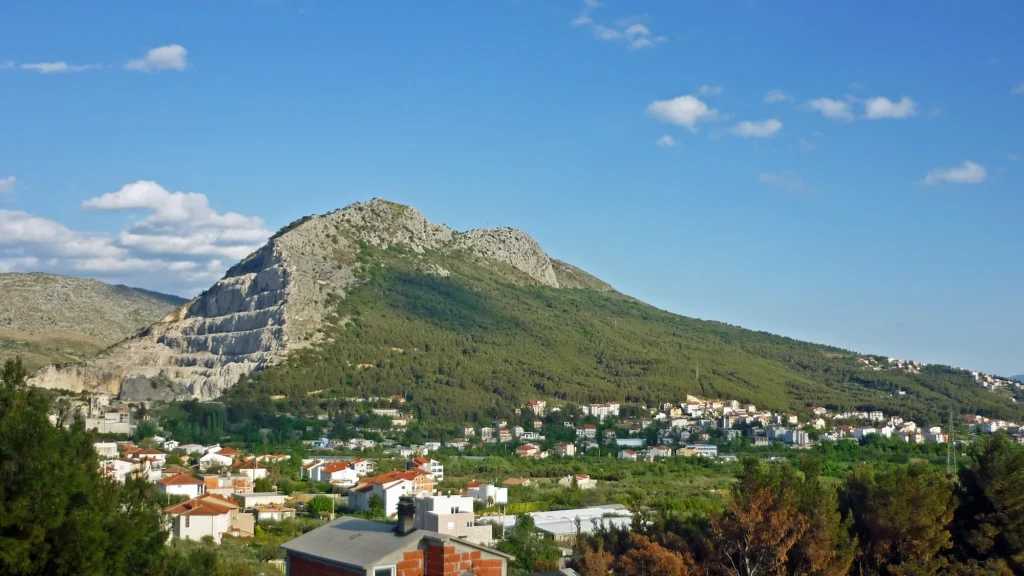
Just outside Split, above Žrnovnica and Podstrana, rises a ridge that is still called Perun. On one of its summits stands a small stone church of St George, the saint who slays the dragon with his spear. Down by the Žrnovnica river there once stood a rock called Zmij kamik, “the serpent’s stone”. The thunderer on the height, the serpent below by the water: many people read the old myth in this landscape, as if it had been written into the hills.
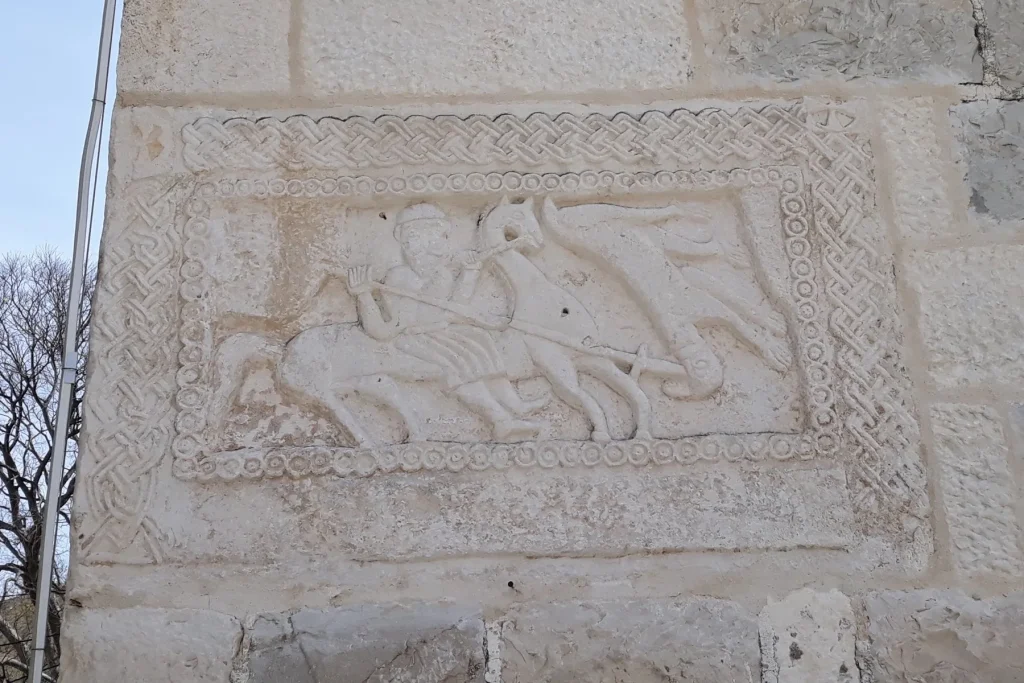
Set into a church wall in Žrnovnica is an old stone relief of a horseman spearing an animal. Whether it shows St George or Perun fighting Veles is still argued over. Perhaps the carver left it that way on purpose, so that everyone could read it their own way.
Učka has a Perun too. A summit of the same name rises above Mošćenice, and a mythological trail leads up to it from Trebišće.
Why we are called Perun
Perun does not belong to any one nation. The Slavs knew their thunderer from the Adriatic to the Baltic, and his name still lives across all of it: in hills, in the word for thunder, in a flower. That is why we chose him. He stands for what the Slavic peoples share: a common heritage, the same folklore, and stories still recognised from Split to Kyiv, whatever the borders in between. He also carries what we strive for in every watch: strength, authority and precision.
The thunder mark on our watches
We carry his mark on our watches. The thunder mark is engraved on the crown of Veles and of the Knez collection, and stamped on the inside of every leather strap we make. There, like the mark on a beam, nobody sees it but the person who wears the watch. We wrote about another Slavic symbol on our watches in The Kolovrat: Meaning and the Slavic Sun Wheel.


Frequently asked questions about Perun
Was Perun the supreme Slavic god?
Probably. The oldest records speak of a god of lightning who is lord of all, and in the sanctuary at Kyiv Perun’s idol stood first. But the Slavs had no single shared religion, so we cannot say that every tribe worshipped him first.
What is Perun’s symbol?
The ones most often named are the oak, the axe, the eagle and the thunder mark, a six-spoked wheel in a circle that people carved into their houses to protect them from lightning.
Who was Perun’s enemy?
Veles, god of the underworld, cattle and wealth, who appears as a serpent or dragon. We know their battle from folk tales and songs.
Which day is Perun’s day?
Thursday. Some western Slavs called it Perun’s day, just as the German Donnerstag is the thunder god’s day. Among Christians, Perun’s role passed to St Elijah, whose feast is on 20 July.
Is the iris named after Perun?
Very probably, and that is how dictionaries explain the Croatian name perunika.
Sources and further reading
- Procopius of Caesarea, History of the Wars VII.14.22-24, translated by H. B. Dewing, LacusCurtius
- The Russian Primary Chronicle: Laurentian Text, translated by S. H. Cross and O. P. Sherbowitz-Wetzor, 1953, entries for 907, 945, 971, 980 and 988, PDF
- Max Vasmer, Etymological Dictionary of the Russian Language, entry Перун
- Gregory Nagy, Greek Mythology and Poetics, 1990, ch. 7, Thunder and the Birth of Humankind
- Radoslav Katičić, Božanski boj, Zagreb and Mošćenička Draga, 2008; and “Čiji to dvor stoji na gori?”, Filologija 48, 2007 (in Croatian)
- Vitomir Belaj, “Poganski bogovi i njihovi kršćanski supstituti”, Studia ethnologica Croatica 21, 2009 (in Croatian)
- Vitomir Belaj and Juraj Belaj, Sveti trokuti: topografija hrvatske mitologije, Zagreb, 2014
- Andrej Pleterski, “Who is Perun?”, Starohrvatska prosvjeta III/42, 2015
- Tomislav Bilić, a critique of the “sacred triangles”, Studia Mythologica Slavica 23, 2020
- Ivan Mužić, “The problem of Saint George in Croatia and Saint George on the church’s relief in Žrnovnica”, Starohrvatska prosvjeta III/38, 2011
- Lars Marius Garshol, “Olav’s Rose, Perun’s Mark, Taranis’s Wheel”, Peregrinations 7/4, 2021
- Featured image: Maxim Vorobiev, Oak Fractured by Lightning, 1842, public domain, Wikimedia Commons