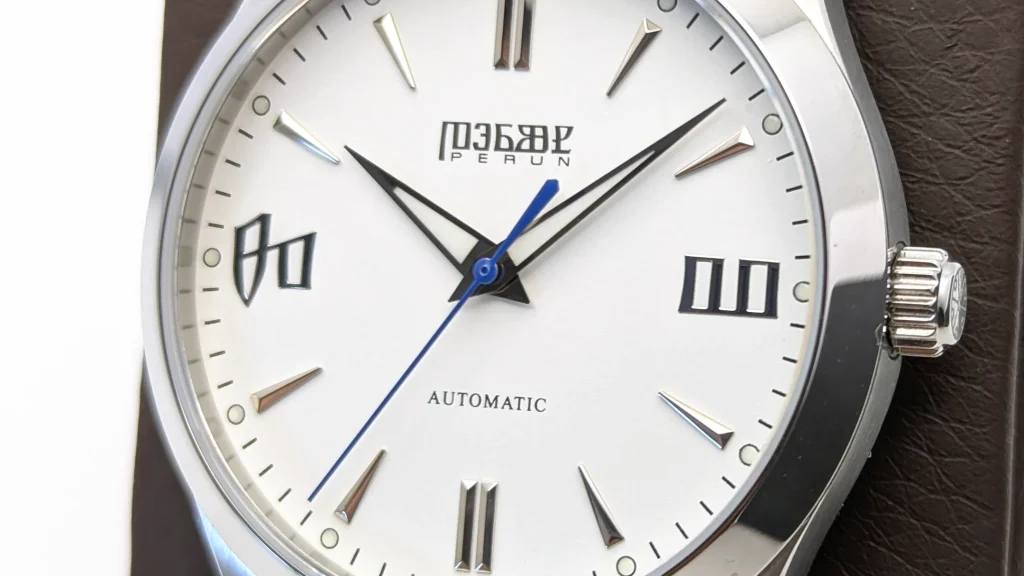
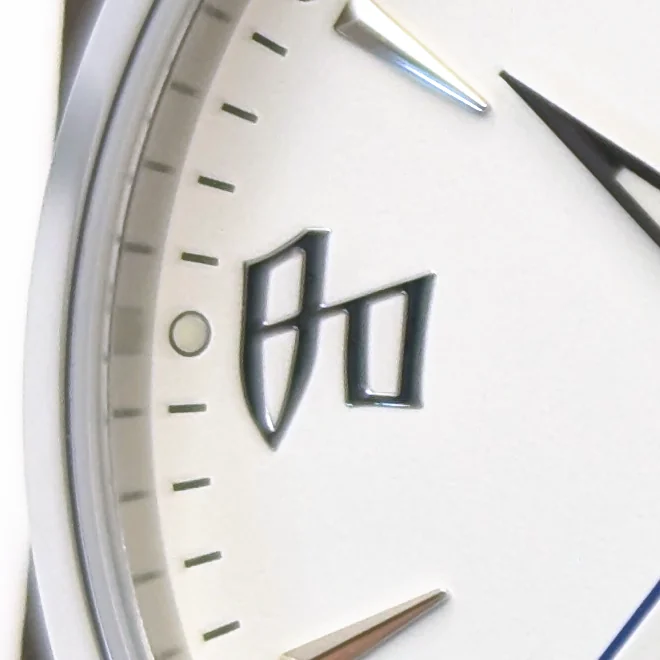
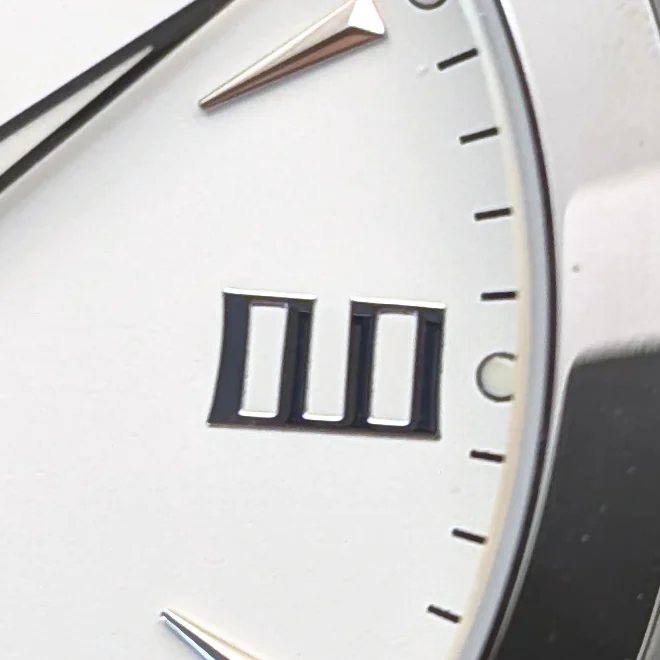
There is no 3 and no 9 on the dial of our Knez watch. In their place sit two letters of the Glagolitic alphabet, vedi and zemlja. They are not there for decoration alone: in Glagolitic, every letter is also a number, and vedi stands for 3, zemlja for 9.
Below you will find a chart of the Glagolitic numerals and how to tell the time on the Knez, followed by a short history of the oldest Slavic script and why it lasted longer in Croatia than anywhere else.
How to read the Knez dial
The Knez reads like any classic watch. You only need to recognise four kinds of marker:
- 12 and 6: double polished batons.
- 3: the letter vedi, the Glagolitic three.
- 9: the letter zemlja, the Glagolitic nine.
- Every other hour: a single polished index, with Super‑LumiNova® dots round the edge of the dial that glow in the dark.
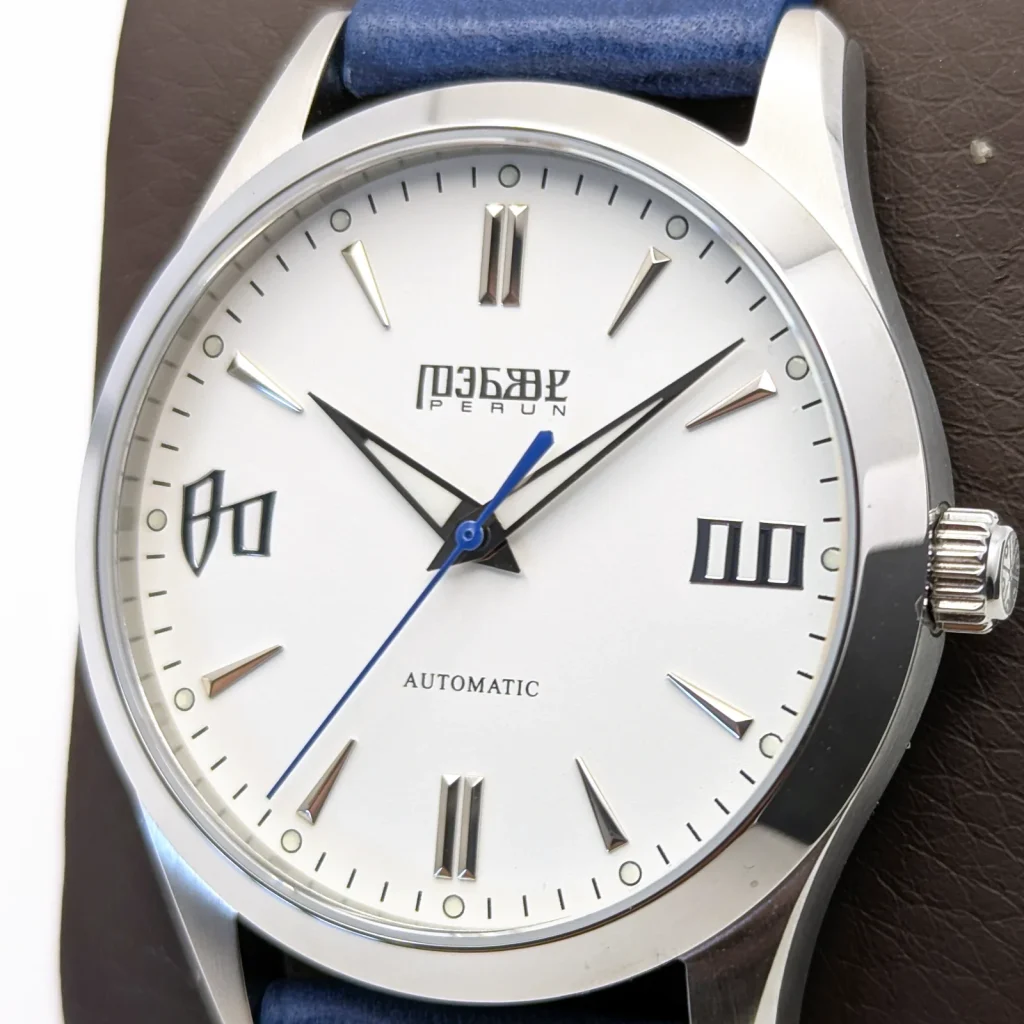
Both numerals are applied: made as separate polished pieces and set onto the dial, so their edges catch the light with every turn of the wrist. Their shapes follow round Glagolitic, the older form of the script. Below the twelve sits our mark, the name PERUN in Glagolitic, with the same name in Latin letters beneath it.
The layout is the same on all five watches in the collection, from the blue Vir to the white Mraz.
Glagolitic numerals: the chart
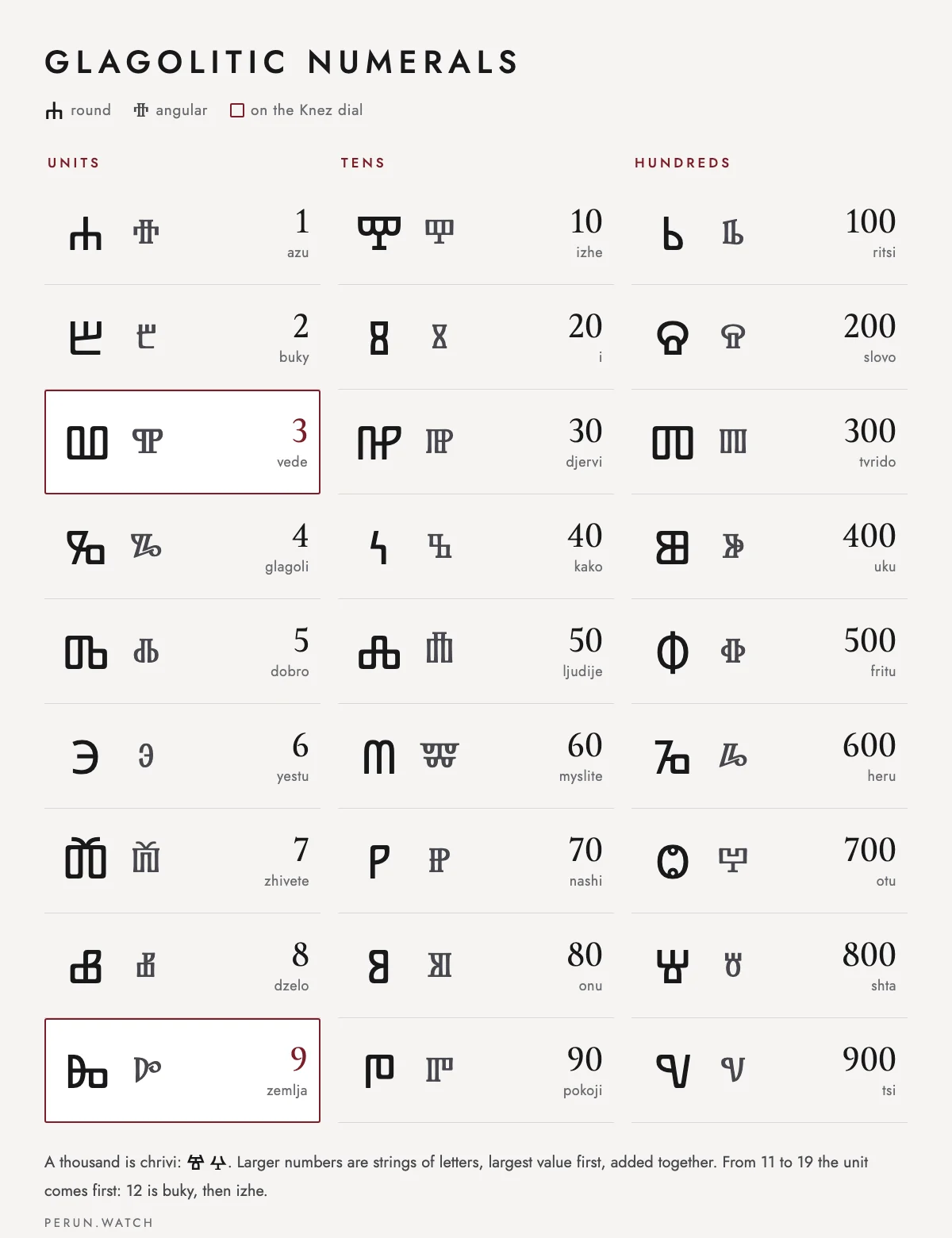
Glagolitic has no separate signs for numbers. As in Greek, where the idea comes from, letters do the counting. The first nine letters of the alphabet are the units from 1 to 9, the next nine the tens from 10 to 90, and the nine after that the hundreds from 100 to 900. The letter chrivi is 1000.
Cyrillic took over the Greek order of numbers as well, so its values jump about. Glagolitic simply counts in alphabetical order, which makes it easy to read: if you know the alphabet, you know the numbers.
A short history of the Glagolitic alphabet
Glagolitic was created in the 9th century by Constantine, better known as Saint Cyril, when he and his brother Methodius set out for Moravia to teach the Slavs in their own language. That language needed a new script. Most scholars hold that Glagolitic is the oldest Slavic script, and that Cyrillic came a little later.
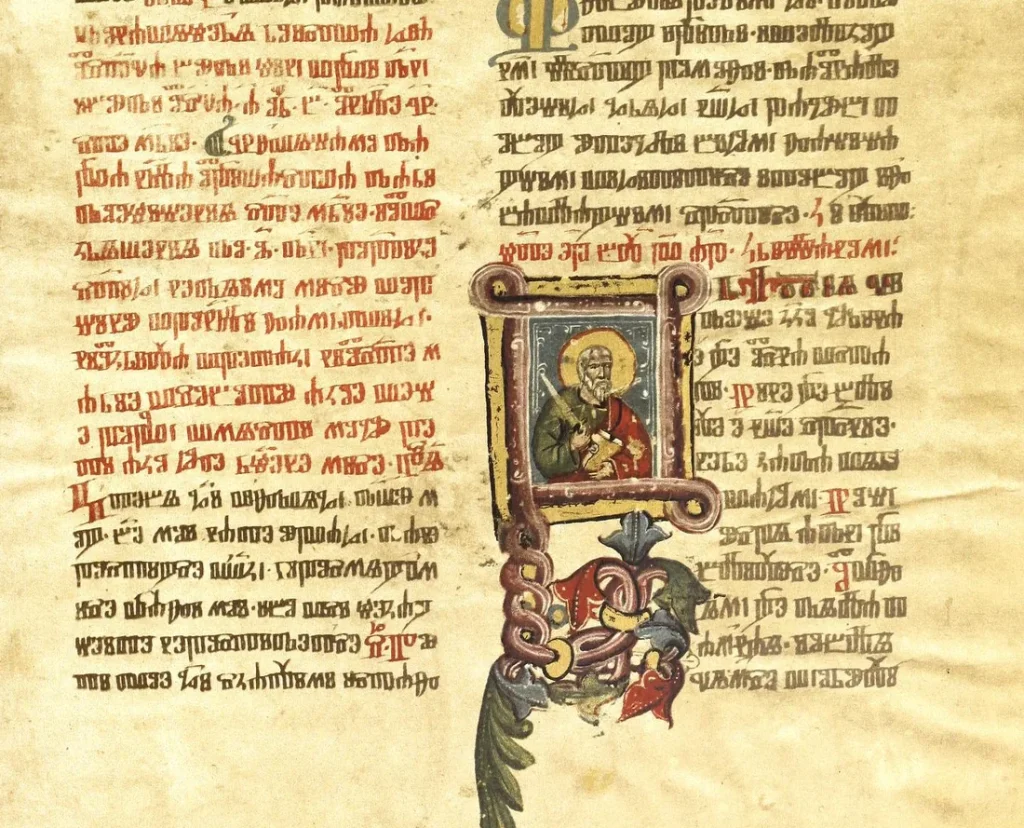
The first letters were round. In Croatia they gradually became upright and angular, and this angular, Croatian Glagolitic reached its height in the 15th century (Croatian Encyclopedia, in Croatian).
The best known Croatian Glagolitic monument is the Baška tablet from the island of Krk, carved around 1100. It records a gift of land from King Zvonimir to the church, and it is now kept in Zagreb, at the Croatian Academy of Sciences and Arts.
Glagolitic survived in Croatia thanks to the glagoljaši, priests who said Mass in Old Church Slavonic and wrote their books in Glagolitic. In Catholic Europe, where the liturgy was in Latin, that was a rare privilege, granted by the pope in the 13th century. Laws and charters were written in Glagolitic too, and in 1483 it was used to print the first Croatian book, a missal.
From the 16th century Glagolitic slowly gave way to the Latin alphabet, but in the churches of the islands, Istria and Dalmatia it lived on for centuries. Nowhere did it last as long as in Croatia.
Why the Knez carries Glagolitic
Knez was the title of the first Croatian rulers, before they were crowned as kings. The same word is carved on the Baška tablet, next to King Zvonimir. Once we had given the collection that name, the script chose itself: the oldest Croatian history is written in Glagolitic.
We wanted it on the dial with restraint. The two numerals sit where the eye looks for a number anyway, so the watch reads easily for someone who has never seen Glagolitic. Those who know it will read something more. We have written about other symbols of our heritage in our posts on the kolovrat and on Veles.
Your name in Glagolitic, on the back of the watch
The Glagolitic on the Knez need not stop at the dial. In place of the standard sapphire caseback you can choose a solid steel caseback with a laser engraving, and the engraving is complimentary. Every Knez page has a “Design your engraving” button. Among the typefaces in the tool it opens are both round and angular Glagolitic: type a name in Latin letters, the tool transcribes it letter by letter and shows straight away how it will look on the watch.
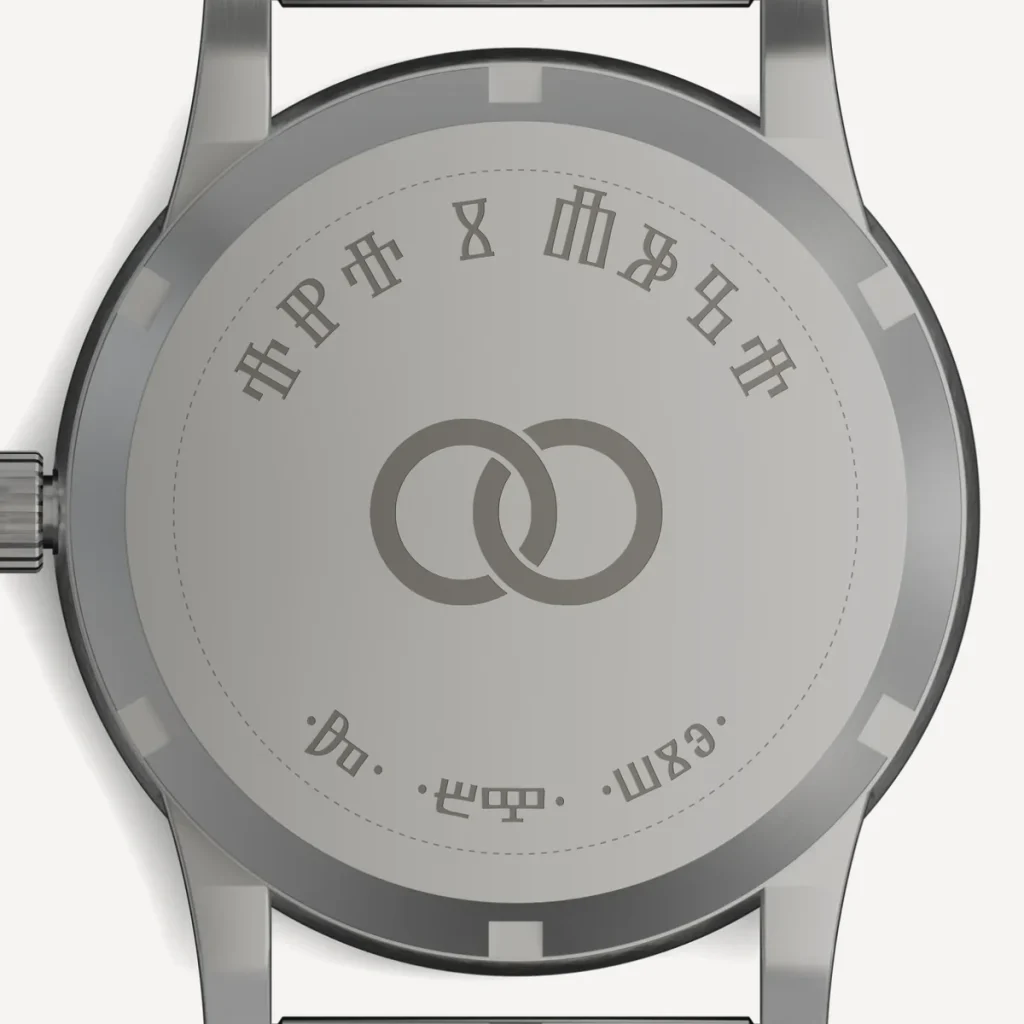
Such a transcription is a modern convention rather than old spelling. Glagolitic has no single letters for the Croatian lj, nj and dž, so they take two, and j and đ share the old letter djervi. A name, a date or a dedication on the back also makes a fine gift, as we wrote in our post on a watch as a confirmation or wedding gift.
Frequently asked questions
How do you write 12 in Glagolitic numerals?
With the letters buky (2) and izhe (10), in that order, because from 11 to 19 the unit comes first. On the Knez, though, twelve is a double baton: only the three and the nine are in Glagolitic.
Is Glagolitic the same as Cyrillic?
No, they are two different scripts. Glagolitic is, in the prevailing view, the older one, while Cyrillic is built on Greek letters and Greek number values. That is why the numbers differ: the letter d is 5 in Glagolitic and 4 in Cyrillic.
What is the difference between round and angular Glagolitic?
Round Glagolitic is the older form, with curved letters, used wherever Glagolitic was written. Angular Glagolitic is the Croatian form, with upright, squared letters, settled by the 13th century. The letters and their number values are the same; only their look differs.
How do I write my name in Glagolitic?
Almost every letter of the Croatian alphabet has a Glagolitic counterpart, which covers most names written in Latin letters. Lj, nj and dž take two letters, and j and đ are written with djervi. The easiest way is to type the name into the engraving tool on any Knez page, which transcribes it into round or angular Glagolitic for you.
Is Glagolitic still used today?
Not as an everyday script. It held on longest in the liturgy, and a Glagolitic missal was still printed in Rome in 1893. Today it lives on in scholarship, on monuments, in design, and every 22 February on the Day of Croatian Glagolitic Script.
Is there a zero in Glagolitic numerals?
No. Numbers were written with letters whose values add up, so a zero was never needed.
Next time you look at the Knez on your wrist, the three and the nine are written in a script more than a thousand years old.